



Kevin Pelton

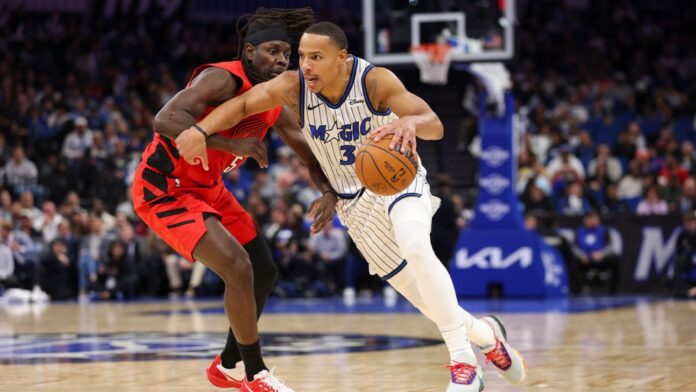
Despite averaging 13.9 points per game and shooting 29% from 3-point range over the season’s first eight games with the Orlando Magic — well below his career mark of 41% — Desmond Bane wasn’t worried.
“It’s so new, I think everybody’s searching,” Bane told ESPN’s Ohm Youngmisuk for a feature story last month. “We [didn’t get] off to the start we wanted. I don’t think it’s anything to panic about. … I’ve been here before … it’s starting the season off, so it’s a hot topic.”
Presumably, Bane didn’t see a presentation by former ESPN analyst Ben Alamar and ESPN’s Dean Oliver at the MIT Sloan Sports Analytics Conference in March. Had Bane known what their research found, it would have validated his confidence that things would turn around.
Using NBA data derived from camera tracking covering all shots off passes from 2016 through 2024, Alamar and Oliver discovered that experience together had a far greater impact than believed by conventional wisdom.
That helps explain why Bane and several of last summer’s most important players to change teams, including Cam Johnson of the Denver Nuggets and Myles Turner of the Milwaukee Bucks, got off to slow shooting starts before rediscovering their usual form. And it offers a useful lesson not to overreact when it happens again.

Familiarity matters for shooting
Alamar and Oliver studied the results for passing and shooting pairs on catch-and-shoot attempts. They found that both the expected value of shots — based on their location and defensive pressure — and the accuracy of those shots relative to expectation increased rapidly with each additional rep between the two players.
Whether the teammates had spent a full season together or not, Alamar and Oliver showed there was a learning curve throughout the season. But that curve was especially challenging for new teammates, who started out shooting about 10% worse on the same shot quality than the mark they reached after 200 combined catch-and-shoots during the same season (a high bar that just 79 duos reached during the 2024-25 regular season, per GeniusIQ tracking). By the second season of playing together, they started the season less than 6% below their eventual peak. And, notably, that peak was higher still in Year 2, suggesting the benefit of familiarity takes more than a single season to accrue.
When combining shot quality and accuracy, the improvement is massive. Alamar and Oliver estimated that effective field goal percentage (accounting for the additional value of 3s) increased from 50% for players’ first catch-and-shoot attempt together to 57.5% for their 100th. That’s enough to go from far worse than league average (around 54% so far in 2025-26) to better than it — just by playing together.
Practical impact this season
Through Halloween, both Bane and Turner might have left their new fans wondering why their teams had invested so much in signing them. Orlando sent four first-round picks and a swap to the Memphis Grizzlies for Bane, and the Bucks created cap space to sign Turner by waiving Damian Lillard and stretching the remaining $110-plus million on Lillard’s contract.
Bane and Turner (a career 36% 3-point shooter who shot 40% last season) were in the NBA’s bottom 15 in 3-point percentage among players with at least 25 attempts in October. Johnson, acquired by Denver from the Brooklyn Nets in exchange for Michael Porter Jr. and an unprotected first-round pick in 2032, wasn’t much better at 32% compared with his 39% career rate.
They weren’t alone in starting slowly. The 53 NBA players who changed teams during the offseason and had played at least 15 games through Sunday collectively shot just 27% from 3-point range during their debuts and were at 33% through four games before regressing to the mean.

We’ve seen that happen rapidly for Johnson and Turner, now shooting 41% and 39% beyond the arc, respectively. The process has been slower for Bane, whose 32% 3-point accuracy would still be easily the worst of his career. However, the rest of Bane’s game has picked up after a sluggish start: He has averaged 22.5 PPG, 5.2 APG and 5.0 RPG over the past 13 games as the Magic have gone 10-3. Bane’s past two games, back-to-back 37-point performances, have been his best so far in Orlando.
The impact so far this season inside the arc is more interesting. Newcomers improved more quickly after a dreadful set of openers but continue to shoot worse than holdover players. Even accounting for player ability using expected 2-point percentages from my SCHOENE projection system, players who changed teams have underperformed their returning peers on 2s thus far.

So far, we’ve focused on the shooting end of the equation, but Alamar and Oliver’s research also suggests an adjustment curve for distributors with new teammates. Lo and behold, point guards who changed teams over the summer have had a difficult start to the season.
Chris Paul and D’Angelo Russell have both been out of their teams’ rotations at times, and Bane’s teammate Tyus Jones, Dennis Schroder and Anfernee Simons have seen their roles limited. Only Jrue Holiday of the Portland Trail Blazers has excelled as a full-time starting point guard on a new team. The Atlanta Hawks’ Nickeil Alexander-Walker and the Sacramento Kings’ Russell Westbrook have had success as combo guards.
Multiple effects of familiarity
My favorite part of the research by Alamar and Oliver is the way it neatly helps explain multiple elements of NBA received wisdom. The most obvious is the value of continuity, something I investigated back in 2019.
Thus far this season, the five teams that have gotten more than 85% of their minutes from returning players have, on average, outperformed their preseason over/under win total pace by about one win each over the first 20 or so games. Meanwhile, the four teams that have returned fewer than 60% of their rosters are all below their over/under pace by an average of more than three wins.
That squares with research I’ve done regarding my preseason wins projections, which incorporate both box score stats and player impact in terms of adjusted plus-minus. I found several years ago that these projections worked differently for players who changed teams, something I attributed primarily to their plus-minus impact, not necessarily traveling with a different set of teammates.
With the benefit of hindsight, it’s now clear that familiarity was part of the reason for this adjustment. Not only were projections more uncertain for players with new teams, but their offensive rating also tended to decline on average, which makes sense in the context of what Alamar and Oliver found.
Looking forward, the value of familiarity offers important context for blockbuster transactions. NBA executives have long been skeptical of championship contenders making major trades midseason, and this research underscores that wariness.
A short-term drop-off is no reason to avoid trading for, say, Luka Doncic at the deadline, given the benefits of adding a superstar in his prime. However, it might explain why the Phoenix Suns disappointed after dealing for Kevin Durant at the 2023 trade deadline and becoming the favorite to win the Western Conference — exacerbated by Durant playing just eight regular-season games after the deal due to injuries. Or why Doncic and Kyrie Irving didn’t click until their first full season together, which ended in the NBA Finals.
Players like Bane, who start the season with new teams, have plenty of runway to build up chemistry with their new teammates. If you’re expecting a deadline pickup to make the difference, he might not have enough time to adjust to his new surroundings.
That offers a lesson to decision-makers to make sure the talent upgrade produced by a trade is worth the loss of familiarity. And it also offers a reminder to the rest of us not to overreact if a player struggles for a few weeks after a trade. The Magic are surely glad they were patient with Bane.
