


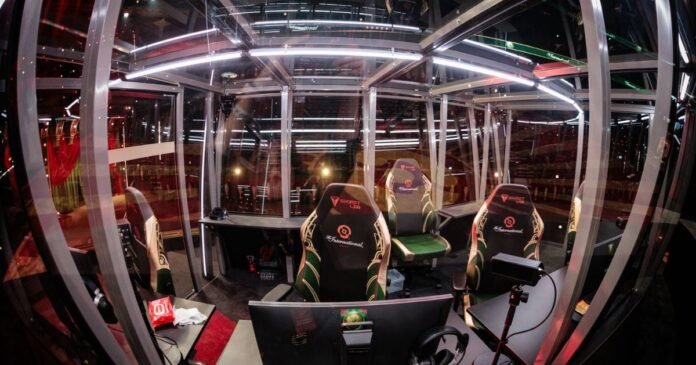
Many esports have used soundproof booths to varying degrees of success. Stemming seemingly from Korean StarCraft: Brood war, where the first soundproof booths were utilized by organizations such as GOM TV and OGN. They were effective enough that players complained when they were removed at one stage of Brood War competition, with pro player . Unfortunately, even with them in place, their effectiveness is questionable, from players.
Simultaneously, IEM and Riot Games became initially notorious for not utilizing soundproof booths for their events. Their reasoning, at least publicly, was that they considered it an obstacle between teams and the crowd, lessening the experience, and that they’re not entirely effective.
Michal “Carmac” Blicharz said as much in : “Soundproof booths are not entirely soundproof. All of the booths I have seen or been inside of dampen 70-80% of the noise. If you add a soundproof headset on top, you will only be aware that there’s a level of noise in the background. No booth will protect you from knowing that the crowd is roaring. From my experience, the headset alone does more than enough to prevent players from hearing anything crucial. At most IEM stages we have the sound set up in such a way that you cannot understand speech if it’s coming out of the speakers.”
Carmac also mentioned that soundproof booths were better for studio environments and cameras, making them more of an issue with televised games. This seems strange when every single esports game is broadcast via streaming (albeit at lower fidelity than any average TV broadcast for most of the industry’s history), but also explains why Korean TV station OGN would have utilized the booths.
Perhaps the most well documented soundproof booths are Valve’s iconic Dota 2 International booths. First used at Gamescom, later at The International in Seattle for many years, they’re also one of the most of a soundproof booth in esports. These booths were an iterative process. The first had numerous issues, with heat so intense the insulated cables started to melt, reflections from the glass showing screens to the opponents.
These were improved upon with the TI2-TI4 design, a more square and boxy design, and finally the TI5 designs which we see today. These things are genuinely feats of engineering. They have museum-standard glass. Each glass pane is a different thickness and slightly angled to diffuse sound. And the cavities between the panes are filled with argon, a noble gas which sound finds harder to travel through.
And the effectiveness is notable. We get a first hand perspective of what it’s like inside these Dota 2 soundproof booths, because Valve has conveniently documented many of them in their series of True Sight documentaries. But even these are not entirely soundproof, with crowd noise audible in the background . Still, these seem pretty incredible in terms of dampening unwanted noises.
But that’s one set of soundproof booths, built bespoke and as detailed in their post, at great expense. And so difficult to transport and construct that Valve even experimented with not using them in 2022 in Singapore, , before bringing them back for 2023 and 2024.
Another problem with working out just how effective soundproof booths are is that it’s very hard to get first hand experience. There are limited chances to go into soundproof booths at events. The reality is, they don’t let people who aren’t referees, techs, or the players and coaches near those things – and rightfully so to prevent other forms of cheating and tampering. And even if you did manage to get in there, there’s no chance the crowd will be cheering for you.
Interviews with players often hint at the effectiveness of soundproof booths, but again there’s still always mentions of the crowd and complaints. When asked flat out pros do prefer the soundproof booths or other methods, such as headphones, the . Ironically, players are not consistent here. Some will say they can still hear the crowd and then state they prefer the booths. Interestingly, the League of Legends pro, Eugene “Pobelter” Park, one of the few players whose career is long enough to have attended LoL events with soundproof booths, suggests he preferred booths until the technology caught up with them.

