


Every summer air brings forth its anthems, and 2024 was no exception. From the smooth vibes of Espresso to the rebellious energy of Brat, music enthusiasts were treated to a rich array of sounds. Yet, one track has not only captured attention but continues to dominate social media, making waves far beyond the usual circles. Hanumankind’s “Big Dawgs” has emerged as a global sensation, resonating deeply with audiences.
The track, marked by its defiance and dominance, has become more than just a hit; it’s a cultural phenomenon. On Spotify, Big Dawgs has amassed over 65 million streams, while on Apple Music, it comfortably sits within the top 50 of global charts. Billboard reflects its widespread appeal, ranking it #11 on the Global 200 and #29 on the Hot 100. The song has also set new standards for Indian independent releases, cementing Hanumankind’s place in the music industry.
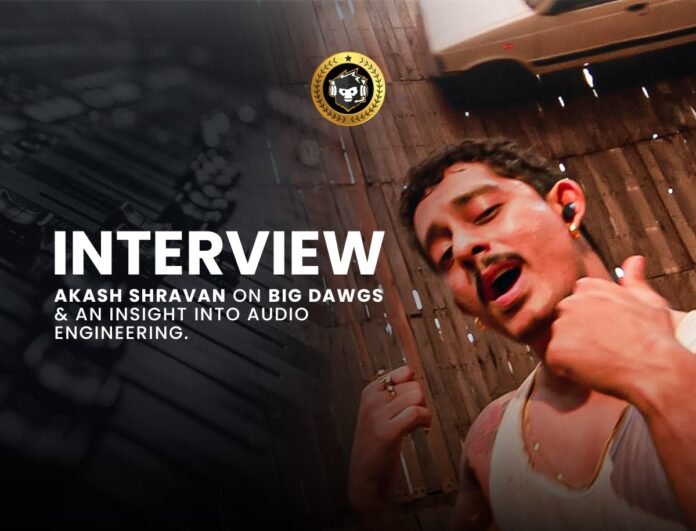
With Big Dawgs ruling the playlists and charts, I had the pleasure of sitting down with one of the key figures behind this hit: Akash Shravan, the mixing and mastering engineer responsible for its polished sound. Our conversation covered his collaboration with Hanumankind, his life as an audio engineer, and his journey through the music industry. Akash also offers insight into the critical role of post-production in music, explaining how mixing and mastering are as vital as the composition itself and provides guidance for those aspiring to pursue this career path.
Concocting the Perfect Composition: Mixing and Mastering in Post-Production
Akash Shravan, a Chennai-based record producer and audio engineer, has quietly built a name in the music industry over the past decade. Starting with piano covers on Facebook and producing tracks in his spare time, Akash recently made his Bollywood debut with the song Khwabida from the film Crew, which he mixed and mastered. His portfolio also includes collaborations with prominent indie artists such as Char Diwari, Yashraj, Baby Jean and Dabzee.
Central to Akash’s work—and the music production process at large—are the often-overlooked steps of mixing and mastering. Mixing involves blending the individual components of a song, like vocals, instruments, and effects, into a cohesive whole, ensuring no element dominates the sound. Mastering, the final stage before distribution, refines the track by adjusting levels, enhancing clarity, and ensuring consistency across playback devices, making it polished and ready for release. These critical processes define the sonic quality of the music listeners hear, setting professionals like Akash apart in an increasingly competitive industry.
“It’s my job to make sure everything is on point, while also following the international standards. You could have the best song in the world, but if the mix is not good, it’s gonna sound like ****. But you could have a very mediocre song, but if it has good mixing, it’s gonna shine,” explains Akash. “When it comes to mixing a song, it will be bare bones initially. It will be very dry. Nothing will have that emotion and this is basically my part: All that contributes to how the song is sounding,” he said.
Music videos add an extra layer of complexity to this process. The audio must not only be pristine but also visually synchronized and compelling. The sound must shift seamlessly with visual transitions, complementing edits, and scene changes to enhance the storytelling.
Akash Shravan further explains how his influences mainly come from the Western side of music, which is where he is the most knowledgeable and comfortable. He prides himself on having a clientele spanning the country who come to him for his sound palate. He adds, “I decide how much the bass should be. I decide how wide it should sound. I decide where it should be placed in the stereo space, while also keeping the artists informed about it because most of them trust me for what I do.”
Big Dawgs’ mixing and mastering, and the sense of depth and space in the track, are certainly pivotal to its worldwide reach and success. With laurels piling up each passing day, Akash Shravan says the reception has been overwhelming. “We are actually competing with top-tier artists right now and for us, we all made this song from our bedrooms within our comfort zone, just like we do any other songs. This time all the pieces of the puzzle fell into place. It’s been very rewarding, but yeah. onto the next one already,” says the engineer.
Akash Shravan’s Association with Hanumankind & His Work on Big Dawgs
Breaking into the music industry as a sound engineer requires a diverse set of skills that go beyond a basic understanding of audio. At the core, sound engineers must possess deep technical knowledge of audio production. This includes an intimate familiarity with digital audio workstations (DAWs) such as Pro Tools, Ableton, or Logic Pro, which are industry standards for recording, editing, and mixing tracks. Mastery of these platforms is essential, but so is a thorough understanding of the physical aspects of sound engineering—everything from microphones, audio interfaces, and mixers to the physics of sound itself, such as frequency, acoustics, and signal flow.
However, technical expertise alone isn’t enough to stand out in a highly competitive field. Sound engineers must also develop a keen ear for the nuances of sound, being able to differentiate subtle variations in tone, pitch, and timbre. This acute auditory sensitivity allows engineers to deliver crisp, balanced mixes that elevate a track’s quality from raw recording to polished final product.
Beyond the technical and auditory skills, the profession also demands strong communication and interpersonal abilities. Collaborating with artists, producers, and other musicians requires sound engineers to interpret creative visions and translate them into soundscapes. Whether it’s capturing the raw emotion in a vocal performance or balancing instruments in a live band recording, effective communication ensures the engineer aligns with the artist’s goals.
Networking is also crucial to landing opportunities as a mixing engineer. Building connections with musicians, producers, and other engineers helps foster collaborations that can lead to long-term partnerships. Many successful sound engineers often find repeat work with the same artists, not only because of their technical abilities but also because of the personal relationships they’ve built.
For Akash, these skills laid the foundation for his career. Having a background in music, particularly piano, gave him a head start in understanding musical structure, and his dedication to expanding his technical abilities allowed him to take on more challenging projects. Combined with his ability to network effectively—like maintaining a professional relationship with Hanumankind and other artists—Akash was able to transition from learning on the go to working on high-profile collaborations.
Akash recalls his first meeting with Indian rapper Hanumankind in Bengaluru, a moment that would eventually lead to a lasting creative partnership. He says Hanumankind and him go way back and adds, “I think 2019 or 2018 I met him because I was performing with my then former gang in Bangalore and he was opening for the event. We got acquainted and stayed in touch.”
During this period, Akash was honing his sound engineering skills, a crucial foundation that would later define his role in their collaborations. When Hanumankind reached out for help mixing a track, Akash was ready for the challenge. Since then, the duo has worked on several projects together including singles like DAMNSON, Genghis, and Go To Sleep; their collaboration evolving into a symbiotic relationship between artist and engineer.
Their most successful collaboration Big Dawgs came together swiftly, Shravan reveals that Hanumankind penned the song in half an hour. “He, I think, wrote it in half an hour and Kalmi (the producer) already had the beat going. And while I was mixing the song, the video was simultaneously happening on the back end. I think we would have taken, in total, a month to pull this off. But yeah, me being on the post-production side, I was only entirely responsible for the audio,” says Shravan.
Akash’s Musical Journey & His Thoughts on Audio Engineering As a Career Path
A by the Indian Council for Research on International Economic Relations (ICRIER) highlights a youth-dominated workforce in the field of sound engineering in India, with 99% of sound engineers being men, and 59% falling in the 26 to 35 age group. The report further indicates that 44% of respondents had been working in the profession for five to ten years, while 33% had less than five years of experience, underscoring the relative youth of these professionals.
Akash’s tryst with music also began at a very young age. An avid Eminem fan and trained piano player, Akash used to upload piano covers on Facebook. He recalls, “A guy from Delhi hit me up on Facebook asking me if I can produce beats. So that was the first time I heard the word ‘produce’.”
This eventually led to Akash Shravan turning into a producer, making beats, “That’s how my journey from the analog and playing actual instruments to the digital world where you can produce beats on a computer happened. That’s where it started. So then it’s just been YouTube tutorials after YouTube tutorials and eventually finding a sound. And it’s been a long journey. I’ve been producing since and I think it’s 12 plus years of doing that,” he explains his entry into the world of music production.
However, Akash Shravan went to university to pursue a degree in commerce and worked for a corporate company after graduation. He says, “You know, you know how brown households are. You need a degree, and then you can do whatever you like. So I did a degree and I got placed. The first job I got…I told myself that it would be the only interview I’ve ever attended in my life. And I’m thankful that that’s how it’s been till now.”
This seems to be the general consensus for most audio engineers in the country who follow a largely informal path, with formal education playing a minimal role. According to the ICRIER survey, only 10% of sound engineers received formal training from specialized music schools. A significant portion, 27%, acquired their skills on the job, while the remainder relied on informal training before entering the profession.
For Akash, a regular 9-to-5 job served as a means to finance his passion for music. “I worked 9-to-5, then produced music from 5-to-9,” he explained, recounting how he learned audio engineering through countless YouTube tutorials. Three years ago, as his income from music began to surpass his day job earnings, Akash made the decision to quit and pursue his craft full-time. He has since registered his practice in Chennai, marking a significant step in his career transition.
According to the ICRIER report, earnings for audio engineers in India can vary significantly based on experience and clientele. Entry-level engineers often earn between INR 16,000 and INR 41,000 per month, while those with more experience can command higher pay, with top professionals bringing in six-figure incomes. However, as Akash points out, reaching that level requires patience and perseverance. He advises aspiring audio engineers to maintain a stable backup income, using those funds to reinvest in their music careers over time.
Akash emphasizes that the key to success in mixing and mastering is practice, combined with a willingness to embrace trial and error. “If you want to make this a stable, six-figure career, it’s going to take time,” he says, calling music production a rich man’s game. He also adds that if money is no bar, the idea is to enroll at a sound engineering school and get started from there, calling it the more traditional route to audio engineering.
There are multiple institutions such as the Film and Television Institute of India (FTII), the National Institute of Film and Fine Arts (NIFFA), and the Sri Aurobindo Centre for Arts and Communication, which have made the profession more accessible for aspirants. Delhi alone boasts over 10 institutes offering sound engineering courses, with more than 700 graduates annually.
However, Akash sees an advantage to learning music and audio engineering on one’s own rather than through formal training. He feels that his learning of audio engineering by himself allowed him to learn things at his own pace, and to pick up new skills. He adds, “It was to my advantage because I was a few steps ahead of other people who would have taken the actual route.”
State of Indie Music in India
It is no doubt that India’s indie music scene has evolved significantly over the past few years. What’s more interesting is that the indie music industry is super diverse, spanning multiple regions and languages, increasing recognition and appeal, both domestically and internationally. The different types of genres, languages, and cultural influences evident in this scene are a testament to India’s diverse spirit. According to , Hip-hop is one of the most popular genres of indie music released in the country. Likewise, a suggested that indie musicians are among the best-selling artists on streaming services in India, generating income for both themselves and other OTT platforms.
Akash Shravan believes that social media has enabled independent music artists to get recognized and has also accelerated the process. “Big, well-acclaimed music directors are starting to work with Instagram-famous people who happen to just have a reel where they’re like singing or doing music, and that would have been a hit. And these guys are approaching them and asking them to be featured in their songs or production,” he adds.
Akash also emphasizes being a good marketer for oneself in the music industry and explains the need to constantly evaluate one’s own work and worth. He advises, “You gotta be cutthroat and ruthless if you wanna be treated right. You gotta be clear with your terms. You gotta be clear with what you’re gonna provide.”
Akash also emphasizes being a good marketer for oneself in the music industry and explains the need to constantly evaluate one’s own work and worth. He advises, “You gotta be cutthroat and ruthless if you wanna be treated right. You gotta be clear with your terms. You gotta be clear with what you’re gonna provide.”
He also explains how the indie music scene is thriving and that the claims of artists not being treated right by record labels and distributors are dying down rapidly. He adds that in the past, the only way to make money being a music artist was to be affiliated with the mainstream movie industry, and points out how social media has changed this equation.
As a freelancer and independent artist, Shravan acknowledges the challenges of securing timely payments. However, he rarely experiences delays in client payments and attributes this to strong negotiation skills and a clear understanding of his worth. “Many freelancers tend to undervalue their work, which affects their earnings,” he explains. “But as your reputation grows, it becomes easier to scale and command higher fees.“
Shravan believes that as an artist climbs the industry ladder, things change dramatically. “As your name starts building value, payments come quicker, and eventually, you’ll find a manager to represent you, taking work calls and upselling your services,” he adds.
For audio engineers like himself, who work behind the scenes, Shravan feels there is less risk of being underpaid. “Nine out of ten times, we release the files only after receiving payment. It’s the performers, playing at clubs or venues, who are more likely to face issues with getting paid,” he explains, reflecting on the challenges faced by artists in live performance settings.
The future for indie artists in India is increasingly promising. With Indian musicians making their mark both domestically and internationally, new studios and distribution companies such as Think Indie are emerging, further fueling the growing interest in independent music. This shift away from traditional movie soundtracks signals a flourishing future for India’s independent music industry. Major brands are also taking notice—Apple featured Paal Dabba’s 170CM in one of its advertisements, while Mercedes showcased Big Dawgs to promote its silver arrows, underscoring the global reach of Indian indie artists.
Looking ahead, the industry’s growth shows no signs of slowing, and Akash Shravan is optimistic about the opportunities on the horizon. Teasing future releases, Shravan hints at upcoming collaborations, including new musical projects with Hanumankind and other artists, signaling bigger ventures in the coming years.

