


David Hale
Close
David Hale
ESPN Staff Writer
- College football reporter.
- Joined ESPN in 2012.
- Graduate of the University of Delaware.
Mark Schlabach
CloseMark Schlabach
ESPN Senior Writer
- Senior college football writer
- Author of seven books on college football
- Graduate of the University of Georgia


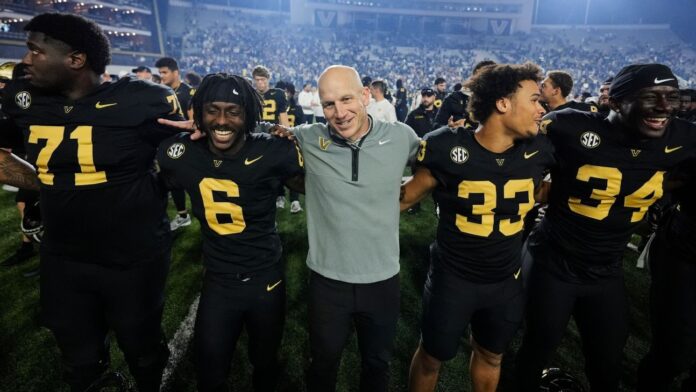
A YEAR INTO his tenure at Vanderbilt, Clark Lea took to the stage at SEC media days in July 2022, and made a bold proclamation: “Vanderbilt football will be the best program in the country.”
The statement drew immediate guffaws, in the room and across social media. No one wins at Vandy. The Commodores hadn’t had a winning season in nine years, and the Commodores hadn’t finished a season in the AP top 20 since 1948.
Lea didn’t care. He had a plan to turn Vandy from a laughingstock into a contender. He and his staff would scour the country for the best underdeveloped recruits, build them over three or four years, and create a culture that made the Commodores unique enough that, eventually, the scales would tip.
Eighteen months later, in December of 2023, Lea sat slumped behind his desk, surrounded by his chief of staff, Ben Cauthen, and his general manager, Barton Simmons, and admitted the plan was dead.
“Things were bleak,” Simmons said. “And Clark was pissed.”
Lea had faced off against the 2021 and 2022 Georgia teams that won national titles. They had third-stringers who were bigger, faster and stronger than most of Vandy’s roster. Meanwhile, Lea watched his best players bolt for the transfer portal for two straight years.
“My greatest fears were being realized,” Lea said. “We were going to be a developmental program for our conference.”
The deck was stacked against him.
But Lea had been thinking about a new approach, something he had floated in bits and pieces to his athletic director, Candice Storey Lee. If Bama and Georgia could spend big on their third-stringers, couldn’t Vandy pay those same guys to be starters?
It’s an idea that has caught on at places like Indiana, Texas Tech and Virginia — all afterthoughts a few years ago, now on the doorstep of the College Football Playoff. The new era of college football — NIL, revenue sharing, the transfer portal, player empowerment — has changed the landscape and allowed every team in the country an opportunity to get into the game, so long as they’re willing to ante up.
At Vandy, it began in that miserable December meeting. He found Storey Lee later and issued something of an ultimatum.
“All of this was snowballing,” Lea said. “If we don’t find $3 million by the time we got to winter of ’24, we weren’t going to have a program.”
Storey Lee wasn’t surprised by the request. In fact, she fully supported it. Lea’s appeal was clear, concise and reasoned. The rest of Lea’s formula didn’t need to change, Storey Lee said. The culture would still underpin the entire program. But if he could convince everyone else at Vandy to aim higher, spend more and get behind a new, audacious plan, Vandy really could become the best program in the country.
Storey Lee had already been laying the groundwork with donors for a few years, and within a week, she had $6 million for her football coach.
“He decided to take a bit of a leap,” Storey Lee said. “In order for him to meet the vision, we had to unhook from some of the things that had been tried and true before.”
SCOTT DOLSON TOOK over as Indiana’s athletic director just ahead of the COVID-19 shutdown in 2020. It was a difficult time to figure out the program’s future, but Dolson wasn’t intimidated. There was already buzz about the coming of NIL, and he believed it could be a space where the Hoosiers excelled. The transfer portal soon followed. The money got bigger. He’d be lying if he said he was prepared for all of it, but what was true about his approach during the height of the chaos engulfing the sport was that Dolson was dreaming big, and in those tenuous moments of change, he saw opportunity.
“We wanted to make certain that regardless of what cards we’re dealt, we need to play them as best we can,” Dolson said.
By the end of 2023, just as Lea and Vanderbilt were wrestling with their own path forward, Dolson was looking for a new coach. He had studied other programs he thought were similar to his, identified key areas where the Hoosiers could grow, and he had a long checklist of assets.
Curt Cignetti checked every box.
“He’s a unicorn,” Dolson said.
Cignetti bolstered Indiana’s roster by embracing NIL and the portal, and he led the Hoosiers to a surprise playoff berth last year.
This season, he has taken the program to even greater heights. Indiana is ranked No. 2 nationally and will face off against Ohio State for a chance to win its first Big Ten title since 1967.
It’s almost impossible to overstate just how unlikely the Hoosiers’ success has been.
“You should never win at Indiana,” said one former Big Ten coach. “They’re the program that, when people would talk about the Big Ten breaking away from their [lesser teams], it was them they were talking about. Now they’re a legit contender.”
The easy explanation for it all is to assume Indiana found the magic formula, one dozens of programs around the country are now eager to mimic. Only, it’s not quite that simple.
“I don’t think it’s true to say whoever raised the most money, that’s who would rise to the top,” Dolson said. “You need to be close to a level playing field to open some recruiting doors that maybe weren’t open before, but that’s what helped us build a program.”
In other words, anyone can spend money, but culture is still a defining feature.
“There’s more entry points right now than there’s been in the past,” said Simmons, Vandy’s GM. “Players see potential in places it didn’t exist before, and they see their own power in changing a place. This era has empowered players to not be shackled by what the history of a place is and they can go and create a legacy.”
In the old days, said Duke coach Manny Diaz, coaches were limited by all sorts of factors outside their orbit — geography, history, facilities, budgets. Now, most of those barriers have crumbled, and with enough cash — like the reported $8 million Duke is paying star QB Darian Mensah — it’s possible to lure talent just about anywhere.
“Retention and acquisition is now all controllable,” Diaz said.
So the money is flowing. At Texas Tech, a program that hadn’t finished a season in the AP Top 25 since 2009, a nearly $30 million roster has changed everything and has the Red Raiders atop the Big 12. Virginia, Duke and other low-profile football programs have followed suit, albeit to a lesser degree.
Georgia coach Kirby Smart compared talent distribution to sand. For a long time, it stacked up in massive dunes. Now, it has spread — though not quite evenly — across the whole beach.
While the new era of college football can only open more windows, it’s up to a program to figure the rest out.
“I think it does reset the market a little bit where schools can look at what’s happened here or Vanderbilt or other schools that haven’t had much success and think, ‘Hey, we can get there as well,'” Dolson said. “The tough part is, not everyone can win.”
TONY ELLIOTT IS an optimist, and so he tells himself every season should come with championship aspirations. Reality tells a different story.
When Elliott arrived at Virginia in December 2021, the facilities were among the worst in the Power 5. The Cavaliers hadn’t finished a season ranked in the AP Top 25 since 2004. There was no money to add marquee talent to the roster. It was an untenable situation.
But Elliott moved quietly — first developing a culture, then selling a vision to donors and administrators, then executing a blueprint he believed could change Virginia’s fate.
Virginia built a new football facility. It retained coaches and expanded its infrastructure. And in 2025, Elliott was finally given a checkbook big enough to attract key talent.
Elliott focused on getting size in the trenches, securing the back end of his defense, and adding a veteran QB. He landed Chandler Morris, a former blue-chip recruit who had been a part of TCU’s 2022 run to the national championship, and Morris arrived with something to prove. In his first address to his new teammates, Morris laid out his mission. He was here to win a championship.
That, as much as anything else, Elliott said, was necessary to changing Virginia’s fate.
“The key is getting the others in all the rooms to believe with the same unshakeable confidence,” Elliott said.
That sounds like the easy part, but it’s not. At places like Virginia, Vanderbilt and Indiana, changing people’s perceptions of what can be accomplished is a massive task.
“It’s not just the effort for X’s and O’s and raising money,” Storey Lee said, “but truly believing at your core that you can change the narrative and execute on that, not falling into default thinking and bad habits that were seemingly entrenched. We had to learn we didn’t have to be beholden to that old narrative. That’s lazy thinking.”
Truth is, Elliott wasn’t sure it would work. But his team got off to a good start, and energy started to build. Then, on a Friday night in September, a top-10 Florida State team arrived in Charlottesville for a game that would shape Virginia’s future.
For home games, the Cavaliers enter the field by walking past the visitor’s tunnel, and the timing usually works out to where the opponent is waiting just inside, about to charge onto the field. Elliott usually doesn’t watch the procession, but this time, he wanted an up-close view. Florida State, even in its lean years, had always been intimidating — bigger, stronger, meaner. Virginia never looked like the Seminoles. Elliott wanted to see if his team would be shaken.
“They didn’t pay any attention,” he said. “They walked right through it. And I thought, ‘They passed the first test.'”
Virginia eventually beat FSU in double overtime. The Cavaliers landed in the top 25 the next week, and they’ve never looked back.
IF THE RULES of program-building have been upended, one hard-and-fast truth hasn’t changed: Wins in college football are a zero-sum game. If Vandy and Indiana go from perennial three-win teams to 10-win contenders, someone else has to start losing.
“It kills the depth on your team,” said former Alabama coach Nick Saban. “Even if you do a great job of recruiting, you almost get penalized. The good players expect to play, and if they don’t play right away — and most of them aren’t ready to play — they want to leave.”
Parity in college football doesn’t mean a bunch of Cinderellas. For many Group of 5 and FCS schools, the current model simply makes them a feeder system.
From 2011-20, the Power 5 conferences dominated their smaller-school foes to the tune of an .874 winning percentage in the regular season, but in the five years since the portal era began, that rate has jumped to .911. Of the 51 players with remaining eligibility who earned first-team all-conference honors in the Group of 5 last year, 38 transferred (35 to Power 4 schools). Coaches at the Group of 5 level have always looked to jump to gigs in a power conference, and now they can bring their best players with them. The foundation of Indiana’s success in 2024 was built on a host of James Madison players who followed Cignetti there.
Big brands also feel the impact. Powers like Alabama, Georgia and Ohio State may not take a huge step back, but they’re thinner on the margins. They’re still getting the best players, by and large; they’re just not getting all of them, and over the course of a season, that might equate to a win or two less.
For some schools, it could spell disaster.
Wisconsin, the school Dolson used as a model for Indiana’s aspirations, went from the second-best record in the Big Ten between 2014 and 2021 to 13th in the four years since.
Two years ago, Florida State won the ACC with a 13-0 record. A year later, the Seminoles finished 2-10 — the cost of a roster exodus of veterans, a lack of ready-made youth to step in and a few major whiffs in the transfer portal.
Penn State and Clemson both opened the 2025 season ranked in the AP top five. Both brought back a number of stars from the prior year. By early November, the two schools were both 3-5. It’s not that either team wasn’t good. It’s just that the margins were smaller, a few bad breaks went against them, then the wheels came off.
“Everyone has good players now,” Diaz said. “When I was at Florida State in the 1990s, we were just better than everybody. It was just stupid. Those days are just gone. So there will be a team like that every year that no one sees that just craters.”
IF COLLEGE FOOTBALL is taking a big step toward a more level playing field, the question now might be whether this is a blip or a new world order.
“Sustainability is going to be a challenge for everybody in college football,” Elliott said. “Now we have to do a good job of supplementing the roster with new guys who believe in doing things the UVA way.”
Everyone has more money now, but Ohio State, Texas and other behemoths still have bank accounts that dwarf an average program. Schools with a handful of billionaire donors have an upper hand, but that’s a small segment of the population. And even those big-money boosters want to know their investment will pay off with wins and a quality culture.
And there are only so many coaches who can take the basic blueprint of modern college football and tailor it to their needs. As Storey Lee noted, Lea’s transition from developmental guru to portal wizard required a lot of humility. Not every coach will do it, and even the ones who do may find what works at one place doesn’t at another.
“If you really believe you’re one of one, you have to maximize what’s best about your space,” Storey Lee said. “Will people try to emulate that? I don’t know. But what feels different now is that we sort of feel comfortable about being unapologetically ourselves.”
Still, the new era of parity is already pushing dozens of programs to become the next Indiana, Vanderbilt or Texas Tech, including by trying to hire coaches like Cignetti and Lea away.
That’s another new twist. When Franklin dragged Vanderbilt into respectability 12 years ago, he quickly left for a bigger, better job. No surprise then that Cignetti, Lea, Georgia Tech’s Brent Key and SMU’s Rhett Lashlee all garnered plenty of buzz for blue bloods in recent weeks. The shocker is that they all stayed put. Sure, hefty contract extensions made their decision a bit easier, but the bigger factor is that they knew they could win right where they were.
Lea has since scored perhaps the biggest blow yet for parity, luring five-star QB Jared Curtis away from Georgia. It’d be easy to see this as Phase 2 of Lea’s vision. If the original goal was to land enough of the talent that wasn’t going to start for a blue blood, the new reality suggests Vandy has built something worthy of even the biggest names.
“We’ve become a really attractive place because this is also different,” Lea said. “People are inspired by the idea of building something and not inheriting something.”
Still, the ultimate indicator of whether parity is the new normal in college football won’t be about Indiana or Texas Tech making a run at a title in 2025. It’s whether they’re still in position to win big in three, 10 or 20 years from now.
Vanderbilt snagging Curtis on the recruiting trail is a coup for all the traditional “have nots,” but the Commodores aren’t alone. Top-10 recruits in the 2026 class are destined for Maryland and Houston. Mississippi State, BYU, Texas Tech and Syracuse all have top-50 recruits committed, too. If the transfer portal opened the door, new players are now eager to kick open other entry points to build something lasting in a sport that suddenly looks a lot different than it did just a few years earlier.
“We don’t think we’re the smartest people in the room,” Dolson said, “but we think we have a great plan and we hope some day, 25 years from now, we’ll say that was the start of a run in Indiana football no one had ever dreamed of.”
